
Featured project
The Buzz (Bumble)
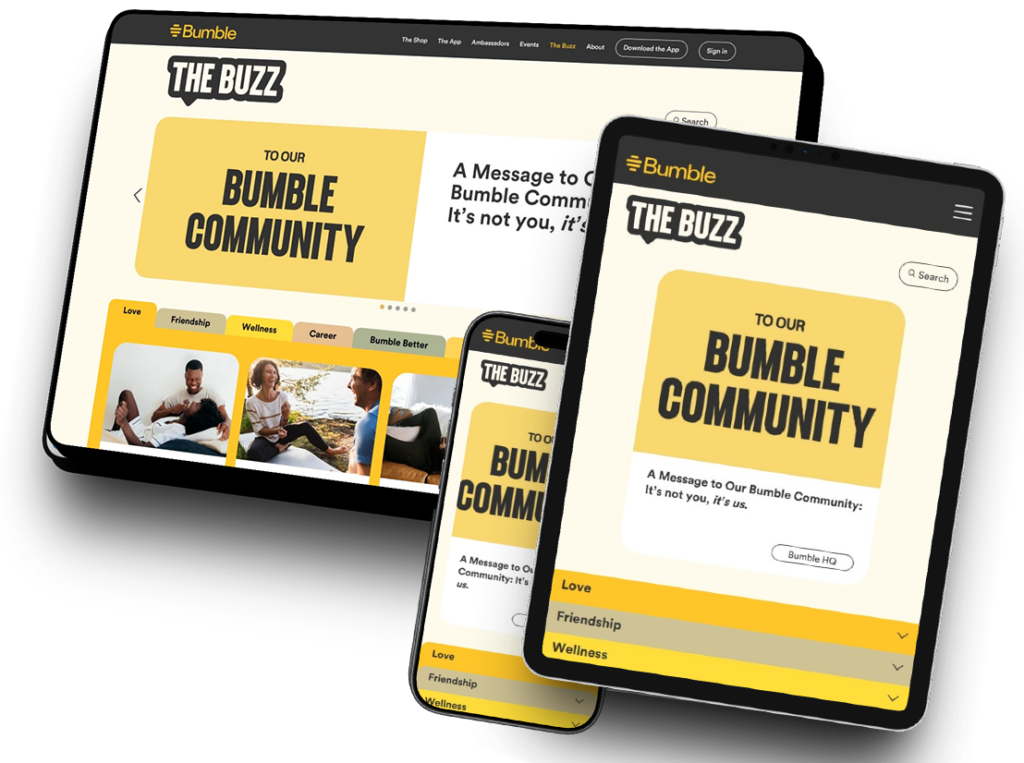
The Buzz serves as Bumble’s large-scale editorial publishing platform, supporting articles submitted by writers and editors across the globe.
Unlike a traditional blog experience, the platform functions as a highly interactive publishing ecosystem with app-inspired interactions, dynamic article systems, accessibility-focused development, and sophisticated responsive behavior across all devices.
Challenges & Solutions
App-Inspired Responsive Interactions
One of the most unique challenges involved adapting Bumble’s mobile app interaction patterns into responsive web experiences.
Featured article sliders and content systems that appeared as traditional desktop layouts needed to transform into swipeable card experiences for tablet and mobile views — closely mirroring Bumble’s familiar “swipe” interactions.
These responsive systems required balancing:
- Touch interactions
- Accessibility behavior
- Responsive performance
- Editorial flexibility
- Cross-device consistency
Responsive Editorial Architecture
The article system itself introduced significant layout complexity throughout both desktop and mobile views.
Challenges included:
- Featured article prioritization
- Responsive article grids
- Swipeable related content
- Dynamic category systems
- Interactive article cards
- Fixed-scroll sidebar behavior
- Conditional featured article logic
Additional custom field logic and conditional rendering systems were implemented to manage multiple featured article scenarios across the platform.
Accessibility & Client Collaboration
Accessibility was a major priority throughout the platform, particularly due to the highly interactive nature of many components.
Several sections required extensive collaboration with both the client and project leadership to balance desired functionality with accessible implementation standards.
Some components — including complex tab systems and interactive content behaviors — required thoughtful compromises and detailed accessibility planning to ensure usability remained a priority throughout development.
Infinite Scroll & Third-Party Integration Challenges
The project also involved integrating an infinite scroll system through a third-party plugin that introduced several accessibility limitations.
Because the plugin was not originally designed with accessibility-first implementation in mind, I worked closely with the developer to create alternative solutions and workarounds that improved usability and keyboard accessibility wherever possible. What initially began as a challenging collaboration ultimately became a mutually beneficial experience, helping improve the plugin’s accessibility overall — a win not only for this project, but for future users and implementations as well.
The Final Result
Highly interactive.
Accessibility-conscious.
Every swipe interaction, responsive layout, and editorial content system was carefully developed to balance performance, usability, and accessibility across a large-scale publishing platform.
What began as a highly complex editorial experience evolved into a polished and scalable content ecosystem that successfully blended app-inspired interactions with thoughtful front-end engineering and accessibility-first development.
